What Is Aluminum Wiring and Which Ontario Homes Have It?
During the mid-1960s and through the 1970s, the price of copper skyrocketed. Home builders and electricians across North America switched to aluminum wiring as a cheaper alternative. In Ontario, this era produced hundreds of thousands of homes — many of them in Brampton, Mississauga, and other GTA communities — that were wired entirely or partially with aluminum.
If your home was built between 1965 and 1978, there is a real chance it has aluminum wiring. In some areas of Peel Region, the estimate is that as many as one in three homes from that era still has the original aluminum branch circuit wiring.
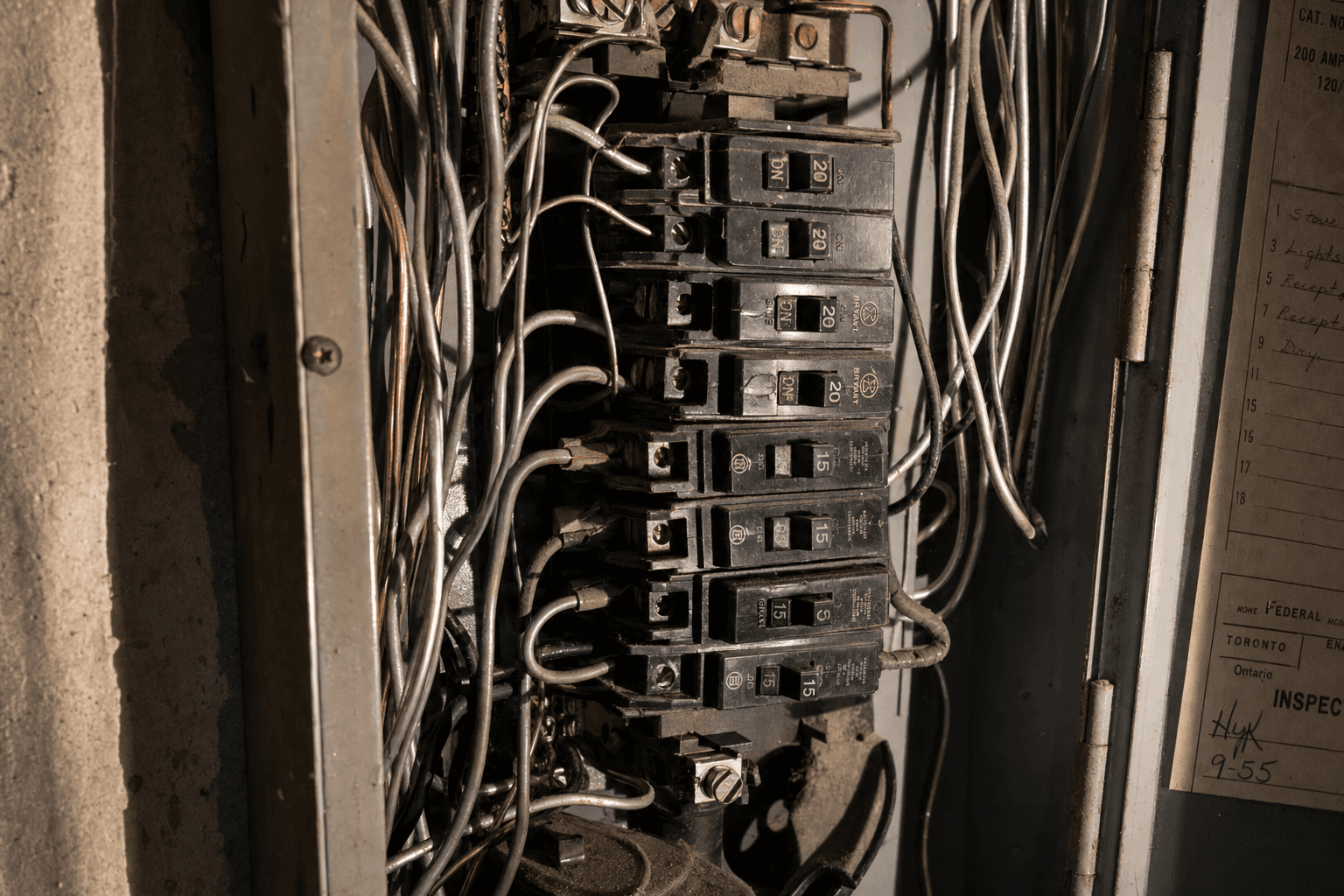
Aluminum wiring looks like regular wiring except the conductors are silver-coloured instead of the warm orange-copper colour you normally see. You might spot it in your electrical panel, in your attic, or in any exposed wiring in your basement or utility room.
Is Aluminum Wiring Actually Dangerous?
The short answer is: aluminum wiring is not inherently dangerous, but poorly maintained aluminum wiring is a documented fire hazard.
Here is the problem. Aluminum expands and contracts with heat more than copper does. Every time a circuit draws power, the wire heats up slightly and expands. When the circuit is off, it cools and contracts. Over years and decades, this movement causes the wire connections at outlets, switches, and fixtures to loosen. Loose connections create resistance. Resistance creates heat. Heat, in an electrical connection buried inside a wall, creates fire.
The U.S. Consumer Product Safety Commission found that homes with aluminum wiring are 55 times more likely to have a connection reach fire-hazard conditions than homes with copper wiring. The Electrical Safety Authority of Ontario takes the same position.
The risk is not the wire itself — it is the connections. Aluminum also oxidizes differently than copper, forming a resistive oxide layer at connection points that accelerates the heating problem.
How to Tell If Your Home Has Aluminum Wiring
There are several ways to check without opening your walls.
Check your electrical panel. Open the panel door (do not touch anything inside) and look at the wiring. Aluminum conductors are noticeably silver or grey, compared to the warm orange colour of copper. If you see silver-coloured wires, you likely have aluminum.
Check your outlets. If you remove an outlet cover plate (with the breaker off), you may see the wire entering the outlet box. Silver-coloured wire is aluminum. Also look for the letters AL or CO/ALR stamped on your outlets and switches — these indicate aluminum-rated components.
Check your attic or basement. Exposed wiring in unfinished spaces is the easiest place to see the conductor colour directly.
Look for warning signs. Outlets and switches that are warm to the touch, flickering lights, circuit breakers that trip for no apparent reason, or a slight burning smell near outlets are all signals that aluminum connections may be degrading.
If you are not sure, book a $49 on-site assessment. We will check every panel connection and any accessible wiring and give you a clear picture of what you are dealing with.
The Insurance Problem: What Ontario Insurers Say About Aluminum Wiring
This is where aluminum wiring becomes a serious financial issue, not just a safety concern.
Many Ontario home insurance companies will not insure a home with aluminum wiring, or they will charge significantly higher premiums. Some insurers require a licensed electrical inspection and may require remediation work as a condition of coverage.
If you are buying a home in Brampton or Mississauga that was built in the late 1960s or 1970s, ask specifically about aluminum wiring before you finalize the sale. Your home inspector should identify it. If the home has aluminum wiring, get a quote for remediation as part of your purchase negotiation.
If you already own a home with aluminum wiring, call your insurer and ask directly whether it affects your coverage. Do not assume you are covered. Some homeowners have discovered their policy was void only after a claim was denied.
Your Three Options for Aluminum Wiring in Ontario
If you have aluminum wiring, you have three real options. Here is an honest breakdown of each.
Option 1 - Pigtailing with approved connectors. The most common approach is to add a short length of copper wire (the pigtail) at every connection point — outlets, switches, fixtures — using an approved connector. The Electrical Safety Authority accepts two types: COPALUM crimp connectors (installed with a special tool) and AlumiConn push-in connectors. This is less expensive than full rewiring and eliminates the dangerous loose-connection problem at every point in the circuit. Cost: $800 to $2,500 for a typical 3-bedroom home depending on the number of devices.
Option 2 - Partial rewiring of high-risk areas. Kitchens and bathrooms have the highest electrical load and the most connections. Rewiring just these areas with copper is a targeted approach that addresses the highest-risk circuits. Cost: $1,500 to $4,000 depending on scope.
Option 3 - Full home rewiring. The most thorough solution. All aluminum branch circuits are replaced with copper. This is the cleanest answer for insurance purposes and eliminates the issue entirely. Cost: $8,000 to $20,000 depending on home size and existing access. For a full electrical rewiring quote, book an assessment.
We will give you our honest recommendation for your specific situation — not the most expensive option.
What to Do Next
If you suspect your home has aluminum wiring, the first step is a professional assessment. Do not ignore it and do not assume it is fine because nothing has gone wrong yet. The failure mode for aluminum wiring is slow and invisible until it is not.
Superior Power Electric has assessed and remediated aluminum wiring in homes across Brampton, Mississauga, Caledon, and the broader GTA. Our ESA licence number is 7014710. All remediation work is fully permitted and inspected.
Book your $49 on-site assessment at (647) 872-9954 or online. We will check your wiring, document what we find, and give you a clear flat-rate quote for the recommended fix. The $49 is credited toward the work if you proceed.
Our ESA licence number is 7014710.
Common questions
Frequently asked
How do I know if my house has aluminum wiring?
Check your electrical panel for silver-coloured conductors (copper is orange-brown). Look for AL or CO/ALR labels on outlets and switches. If your home was built between 1965 and 1978, have a licensed electrician inspect it. Superior Power Electric offers a $49 on-site assessment that includes a full wiring check.
Is aluminum wiring illegal in Ontario?
Aluminum wiring is not illegal in Ontario. Homes with original aluminum wiring from the 1960s and 1970s are not required to rewire unless they are undergoing significant renovation. However, insurance companies may refuse to cover homes with aluminum wiring, which is a practical problem for most homeowners.
How much does it cost to fix aluminum wiring in Ontario?
Pigtailing every connection in a typical 3-bedroom home costs $800 to $2,500. Partial rewiring of high-risk areas (kitchen, bathrooms) costs $1,500 to $4,000. Full home rewiring costs $8,000 to $20,000 depending on home size. A $49 on-site assessment will determine which option is right for your home.
Will my insurance company insure a home with aluminum wiring?
Many Ontario insurers will not insure homes with aluminum wiring, or they charge significantly higher premiums. Some require a licensed electrical inspection and written confirmation of the wiring condition as a condition of coverage. Contact your insurer directly and disclose the wiring type accurately.
Can I rewire my house myself to fix aluminum wiring?
No. Electrical rewiring in Ontario must be performed by an ESA-licensed electrician with a proper permit and inspection. Unpermitted work is illegal, void of warranty, and will not satisfy insurance company requirements. Pigtailing also requires approved connectors and correct installation technique to be effective.
Shaun Pennant
Master Electrician, ESA/ECRA #7014710
Licensed master electrician with 15+ years serving Brampton and the Greater Toronto Area. Founded Superior Power Electric in 2020.