Standby and portable generator installation, done to code
What does it actually cost to never lose power again?
A portable generator inlet with an interlock runs $800 to $2,000 and covers the essentials. A full automatic standby system that kicks in before your fridge notices the outage runs $8,000 to $16,000+ installed. Both need an ESA permit and a real transfer switch. Neither one involves an extension cord through a window.
The $49 comes off your project. Free remote estimates from photos.
 ESA/ECRA #7014710
The 20-second version
If you read nothing else on this page, read these.
- Backfeeding through a dryer or range outlet is illegal in Ontario and can kill a line worker fixing the pole outside your house.
- A manual transfer switch or CSA-approved interlock is the legal floor. There's no version of 'just wing it' that passes inspection.
- Budget path: portable generator plus inlet and interlock, $800 to $2,000.
- Set-it-and-forget-it path: automatic standby unit plus pad, transfer switch, and wiring, commonly $8,000 to $16,000+.
- Gas piping is a licensed gasfitter's job. We coordinate it, we don't fake it.
Every question, answered
Ask us anything. Here is all of it.
Money
Why is there such a huge price gap between $800 and $16,000?
Because they're not the same job wearing different pants. The cheap end is a locking inlet on your siding and an interlock kit in your existing panel, built around a portable generator you wheel out and plug in yourself. The expensive end is a permanently installed engine, a concrete pad, an automatic transfer switch, and gas piping run by a licensed gasfitter. One needs you. The other doesn't.
Is the $49 assessment worth it for something this expensive?
More worth it than usual. On a $12,000 decision, guessing costs you real money. We look at your panel, your gas meter capacity, where a pad can legally sit relative to windows and property lines, and what you actually want covered. That $49 gets credited straight to the job if you move forward.
Does Financeit work for a standby system?
Yes. Standby systems are exactly the kind of job people finance, because paying it off over a couple years beats writing one cheque the week your basement floods from a sump pump that stopped running.
Why do quotes vary so much between electricians for the same generator?
Usually it's what's hiding in the quote. Some numbers include the pad, the gas line coordination, and the permit. Some don't, and you find out later. Ask what's excluded before you compare two numbers side by side.
Standby vs portable
What's the actual difference, in plain terms?
A portable generator is a machine you store in the garage and drag out when the power dies. A standby unit lives outside permanently, hooked to your gas line, and starts itself within seconds of an outage, whether you're home or in Cancun. One requires you to be present and awake at 2am. The other doesn't care what time it is.
Can I just buy a portable generator and run it myself without any electrical work?
You can run it, but not into your house safely without an inlet and transfer switch. Without that hardware you're stuck running extension cords to individual appliances through a cracked door, which is inefficient, a tripping hazard, and still doesn't touch your furnace or well pump.
How much power does each option actually give me?
Portable units in the budget range typically run 7,000 to 10,000 watts, enough for a fridge, sump pump, furnace blower, and some lights and outlets through an essential-circuits setup. Standby units start around 14kW and go well past 20kW, enough to run the whole house including AC without you thinking about it.
Which one do most Brampton homeowners actually pick?
It splits roughly on how bad your last outage was. People who lost a sump pump and flooded a basement tend to go standby. People who just want the fridge and furnace covered for a storm or two a year tend to go portable with an inlet.
What stays on
Does a generator run my whole house or just some of it?
Depends on the size you buy and how the transfer switch is wired. A budget setup usually feeds an essential-circuits sub-panel: furnace, fridge, sump pump, some lights and outlets. A large standby unit can run everything, AC included, but you pay for that capacity.
Who decides what counts as 'essential'?
You do, we just ask the right questions. Sump pump and furnace are non-negotiable for most people. After that it's your call: home office, freezer, garage door opener, the works. We size the transfer switch and generator to match what you actually pick, not what's easiest to sell you.
Can I upgrade from essential circuits to whole-home later?
Sometimes, if the panel and generator have room to grow. It's cheaper to plan for it now than to redo the transfer switch in three years. Tell us during the assessment if whole-home coverage is a maybe-later, not a definitely-not.
Will it run my air conditioner?
Portable and mid-size standby units usually can't start a central AC compressor without a soft-start add-on, because the startup surge is bigger than the running load. Larger standby units handle it fine. We'll tell you straight whether your AC makes the cut before you buy anything.
Safety and the law
Why can't I backfeed through the dryer outlet?
Because that outlet has no idea the grid is down. Backfeeding sends your generator's power out through your house wiring, back through the meter, and onto the street lines, the same lines a hydro crew thinks are dead. A lineworker touching what they believe is a de-energized wire can be electrocuted. This isn't a technicality, it's the single most dangerous thing a homeowner can do with a generator.
Can I just run an extension cord from my neighbour's generator?
Same problem, smaller cord. Any connection that ties a generator into your house wiring without a transfer switch or interlock can backfeed the grid the exact same way. It doesn't matter whose generator it is or how thick the cord looks.
What's a CSA-approved interlock, actually?
It's a metal bracket inside your panel that makes it physically impossible to have the main breaker and the generator breaker on at the same time. No software, no trusting yourself to remember. If one's on, the other can't be. That's the whole trick, and it's why inspectors accept it as a legal alternative to a manual transfer switch.
Do I really need an ESA permit for this?
Yes, every time, no exceptions we've found. Skipping the permit can void your home insurance if a fire or injury ever traces back to the generator hookup, and it can stall a home sale when the buyer's lawyer asks for proof of a permitted electrical connection. We pull the permit as part of every job.
Install day
How long does a portable inlet and interlock take?
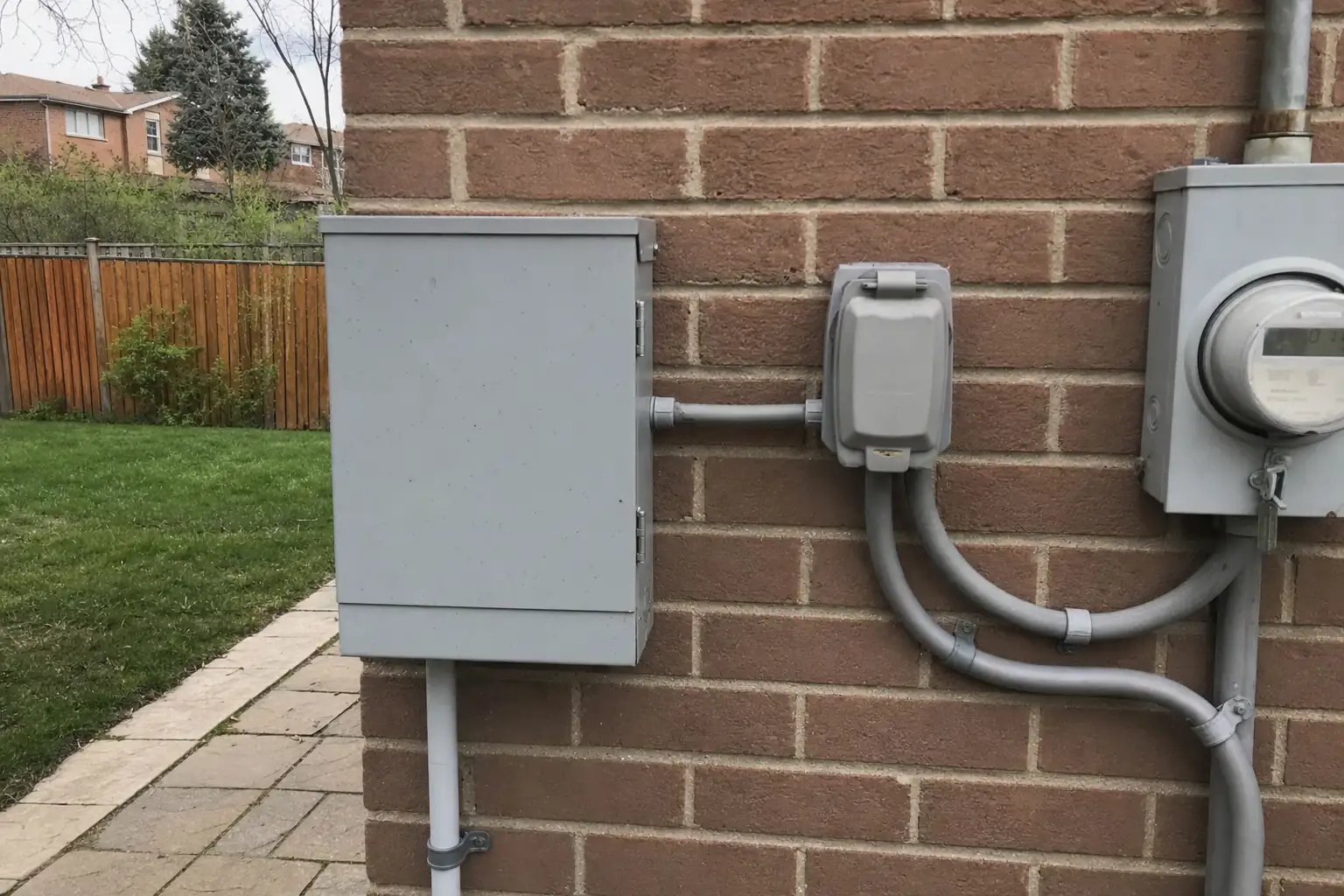
Usually a few hours, sometimes done same day. We mount the inlet box outside, run wire to the panel, install the interlock kit, and test it by actually starting the generator and flipping the switch, not just eyeballing it.
How long does a full standby install take?
A full day for the electrical and pad work, then a separate visit from the gasfitter for the gas line, then the ESA inspection. Most homeowners are looking at roughly a week from start to a working, inspected system, depending on permit and gasfitter scheduling.
Where does the unit go? Can it sit anywhere?
No, and this trips people up. Standby units need clearance from windows, doors, and property lines, and they can't sit right under a bedroom window because of the noise and exhaust. We check the setback rules for your lot during the assessment so you're not staring at a rejected permit later.
Do I need to be home for the whole thing?
For the electrical work, no, though it helps for the walkthrough at the end. For the ESA inspection, someone usually needs to provide access. We'll tell you exactly which day needs you around.
Gas and fuel
Do you run the gas line yourselves?
No, and we won't pretend to. Gas piping is a licensed gasfitter's job, full stop. We coordinate the scheduling so it lines up with our electrical work, but the actual gas connection is priced and performed separately by someone licensed to do it.
Natural gas or propane, does it matter for the electrical side?
Not much for us, it mainly changes the gasfitter's scope and your ongoing fuel cost. Natural gas is the common choice if your house already has a gas meter with enough capacity. Propane works fine where natural gas isn't available, you just need a tank.
What if my gas meter doesn't have enough capacity for a generator?
It happens, especially on older homes with a furnace, water heater, and stove already pulling from a small meter. The gasfitter checks this before anything gets installed, and sometimes the gas company needs to upsize the meter first. Better to find out during planning than after the pad is poured.
Do portable generators need the same gas coordination?
Usually not, most portables run on gasoline you fill yourself, which is exactly why they're the cheaper, simpler path. No gas line, no gasfitter, no meter capacity conversation. You trade convenience for the errand of keeping fuel on hand.
Money, straight up
What it actually costs
Real ranges from real jobs across Brampton and the GTA. Where your project lands depends on your panel condition, gas meter capacity, and how much of the house you want covered.
These are typical ranges from past Brampton and GTA projects, not a quote for your house. Panel condition, gas meter capacity, and pad location can move the number. Book the $49 assessment for an exact price, credited to your project if you proceed.
| The job | Typical range | What moves the number |
|---|---|---|
| Portable generator inlet + interlock | $800 - $2,000 | Inlet box, wiring to panel, CSA interlock kit, testing |
| Manual transfer switch setup | $1,500 - $3,500 | Dedicated sub-panel for essential circuits, manual switch |
| Automatic standby system (electrical only) | $5,000 - $9,000 | Unit mounting, pad, automatic transfer switch, panel wiring |
| Automatic standby, fully installed | $8,000 - $16,000+ | Includes unit, pad, transfer switch, wiring; gas piping priced separately by gasfitter |
| Gas line run (by licensed gasfitter) | Quoted separately | Depends on distance from meter and whether meter needs upsizing |
| ESA permit and inspection | Included in project quote | Mandatory on every generator hookup, no exceptions |
No mystery process
What happens when you call
What actually happens from the day you call to the day the ESA signs off.
- 1
Book the $49 assessment
A licensed electrician looks at your panel, your gas meter, and your lot to figure out setback clearances. You get a real number, not a guess over the phone.
- 2
Pick your path
Portable inlet and interlock, or full automatic standby. We size the transfer switch to whatever circuits you actually want to keep running.
- 3
Coordinate the gasfitter (standby only)
If you're going standby, the gas line gets scheduled with a licensed gasfitter to line up with our install day. Portable path skips this entirely.
- 4
Install and test
Inlet and interlock jobs are often same day. Full standby installs run about a day for electrical and pad work. Either way we actually start the generator and test the transfer before calling it done.
- 5
ESA inspection and certificate
We pull the permit and handle the inspection. You get the certificate of inspection for your insurance file and for whenever you sell the house.
Things the internet got wrong
Myth vs. fact
“I can backfeed through my dryer outlet in an emergency, just this once.”
Backfeeding can send live power out onto grid lines that hydro crews believe are dead, which can kill a line worker. It's illegal in Ontario for exactly that reason, and there's no version of 'just this once' that makes it safe.
“Any generator will keep my whole house running.”
Only if it's sized and wired for that. A small portable unit through an essential-circuits switch covers your fridge and furnace, not your central AC. Whole-home coverage needs a larger standby unit and a matched transfer switch.
“A generator hookup doesn't need a permit if it's 'just a plug.'”
Every generator connection to your house wiring needs an ESA permit, inlet-and-interlock included. Skipping it can void your insurance and cause problems when you sell.
“Standby generators are too expensive to be worth it.”
For some homes, sure. But if you've ever had a sump pump quit during a storm and flood a finished basement, the math on an $8,000 to $16,000 standby system looks a lot different than it did before the cleanup bill.
“I can install the transfer switch myself and just get it inspected after.”
ESA permits need to be pulled before the work in most cases, and DIY panel work on your main electrical service is exactly the kind of job that voids insurance if it's done wrong. This is licensed electrician territory.
Walk away if...
- Suggests backfeeding through a dryer or range outlet to save money
- Won't mention an ESA permit unless you ask first
- Can't tell you what a CSA-approved interlock is
- Quotes the generator unit price with no mention of the pad, transfer switch, or gas coordination
- No fixed business address or ECRA/ESA licence number
A good electrician will...
- Brings up backfeeding risk before you do, and explains why it's dangerous
- Includes the ESA permit and inspection in the written quote
- Asks what circuits matter to you before recommending a size
- Coordinates directly with a licensed gasfitter for standby installs
- Shows you the ECRA/ESA licence number without being asked
Around here specifically
Built for GTA winters and summers, not showroom weather
Brampton and the wider GTA get two flavours of outage: winter ice storms that take down lines for days, and summer heat waves that push the grid hard enough to trip rolling brownouts. Alectra is the utility across most of our service territory, and outage patterns here favour either a solid essential-circuits setup or a standby unit sized for a multi-day event, not just a few hours. Gas line work for standby systems is always handled by a licensed gasfitter, which we coordinate as part of the project so you're not chasing two separate contractors.
Still have a question we missed?
Call and ask it. A licensed electrician answers, and honest advice is free even when the job isn't ours.